Page 5 of 6

Year 10 Lichen Lesson on Environmental Indicators

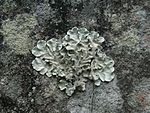
Lichens are Fungi, and are really interesting.The plant-like appearance of lichen hides their true identity. A lichen is not a single organism, but the result of a partnership (mutualistic symbiosis) between a fungus and an alga or cyanobacteria. Not just that, lichens are bio-indicators. Bio-indicators are living organisms that respond in an especially clear way to a change in the environment. The hardy lichens are useful bio-indicators for air pollution, especially sulfur dioxide pollution, since they derive their water and essential nutrients mainly from the atmosphere rather than from the soil. It also helps that they are able to react to air pollutants all year round. Compared with most physical/chemical monitors, they are inexpensive to use in evaluating air pollution. Lichens can also be used to measure toxic elemental pollutants and radioactive metals because they bind these substances in their fungal threads where they concentrate them over time. Environmental scientists can then evaluate this accumulation to determine the history of the local air.

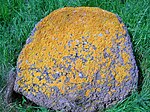
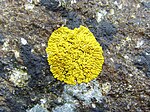
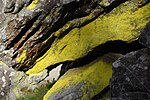
In a air polluted area, you will not find any lichens around the area. Special pigments, such as yellow usnic acid, give lichens a variety of colors, including reds, oranges, yellows, and browns, especially in exposed, dry habitats.

download

To stop air pollution I think we need to try and stop acid rain. To do that we need to stop releasing sulfur into the air. And if lichens do not grow up, it is an air polluted environment. Having a lot a green area will be great, (a green area is where there i slots and lots of trees, grass. etc) because having trees is really helpful in reducing the amount of carbon dioxide (CO2) and increase the amount of oxygen (O2). Having this area far far away from any factories will be really great, because then we can reduce the amount of toxic gasses in the air. Box Hill in Surrey is a free application planning.  And because it has the features that have been stated. The question is, do lichens grow?

The Green Elfcup which stains wood a typical blue green found at Box Hill, Surrey - Stock Image
The answer is yes. This picture of a  lichen is from a website and here is the link http://www.alamy.com/stock-photo/fungi-box-hill-surrey.html, if we can have the same features in area it will be less if not at all polluted. And to know if it is working we should have lichens growing.

Lichens can also indicate if it rains in a specific area or not. In the absence of special pigments, lichens are usually bright green to olive gray when wet, gray or grayish-green to brown when dry.


Explain how Lichens can be environmental indicators.

A lichen is a composite organism that arises from algae or cyanobacteria living among filaments of a fungus in a symbiotic relationship. The combined life form has properties that are very different from the properties of its component organisms.

Image result for Explain how Lichens can be environmental indicators.

Bio indicators are living organisms that respond in an especially clear way to a change in the environment. The hardy lichens are useful bio indicators for air pollution, especially sulfur dioxide pollution, since they derive their water and essential nutrients mainly from the atmosphere rather than from the soil. It also helps that they are able to react to air pollutants all year round. Compared with most physical/chemical monitors, they are inexpensive to use in evaluating air pollution.

Lichens can also be used to measure toxic elemental pollutants and radioactive metals because they bind these substances in their fungal threads where they concentrate them over time. Environmental scientists can then evaluate this accumulation to determine the history of the local air.

The Theory of Natural Selection

Darwin’s theory of natural selection came to his mind when he was done travelling the world. And he saw that species vary from one place to another. Then he said to himself, why is that? Why do some work over here and not over there? Why do some live in here and not in there? And then he thought about how if we did not like something we will get rid of it and get something else to replace it. For example, let’s talk about cows. The cows that we humans like keep to get milk from, however, the cows that we don’t like would become hamburger. So he said if we can do it, why can not nature do it. So he came out the the idea of natural selection.

Darwin defined his idea of natural selection with Genetic organisms will undergo genetic change over time due to natural selection. And he added, if enough changes occur over time (centuries) New species would develop from pre-existing ones .

So we can say that natural selection is those with a genetic trait that increases the chance of offspring will pass their genes on to the next generation more than those without it.

Modern science suggests that there is even something called Genetic Drift, which basically means random changes in small groups
Darwin used some evidence to back him up. Such as Fossils, drawn saw fossils of creatures that are not present today when he was in his journey. So he said these species are gone but they share great semblance to modern species.
Embryology, species that have similar developments from when the egg is fertilized to when they grow up i mean in the embryo stages are more closely related.
Comparative anatomy, lets say when you look at your hands and compare them to the hands of the bats, you can see that they are closely related. But if you look at your hand and a wing of a bee, they are similar.
Molecular Biology, it is a new tool that helps you compare the genes them selves.

Darwin’s theory makes more sense than the Lamarck’s theory. Lamarck’s theory was that the giraffes made their necks grow longer by having one generation stretch then passing that stretch to other generations, and so on so forth that it become the giraffe that we know of today.

What Mass Really Is? Is It Really What We Think It Is?

A Hydrogen atom has less mass then the combined masses of the proton and the electron that make it up. How can something weigh less then the sum of its parts?  Because of “E=mc²”
E=mc² is probably the most famous equation in all of physics. However, what does it really mean? Most surprisingly, in the original 1905 paper, Einstein actually wrote it down as m=E/c². That’s because in the core of it, there is a lesson in how to think about mass.
I have personally used statements like “Mass is frozen Energy”, or “Mass can be converted to energy” to find out, after doing this research, none of them is correct.

What Einstein really wants us to know is that mass is not anything at all. It sounds a bit confusing, however, with these examples we will understand it  hopefully.
Let’s take to watches that are identical atom from atom.
unnamed                                                            clock-animated-gif-17

except that one of them is fully running and ticking, and the other one has stopped. According to Albert Einstein, the ticking watch has greater mass then the one that has stopped. The question is, why? Well, in Einstein’s theory (which is correct), the hand and gear are moving, so they have some kinetic energy. There are also some wound up springs in the running watch that have potential energy, and there is a little bit of a friction between the moving parts and the watch, therefore the parts get heated up that the atoms start jiggling a little bit, that is thermal energy. Now what m=E/c² says is that all of that kinetic and potential and thermal energies that reside in the watch’s parts manifest themselves as part of the watch’s total mass. How does it happen? Simple, You just add up all of  those energies (kinetic, potential, thermal) divide them by the speed of light squared, and that is how much extra mass that those energies contribute to the hole. Since the speed of light squared is too huge which is equal to “8.98755179 × 10¹⁶ m² / s²” the extra mass is too tiny, only about 0.000000000000000001% or 1e-20. This is why, according to Einstein most of us have that mass is an indicator of amount of matter in an object, simply, IT IS NOT! It’s just in everyday life we do not notice, because it is too small, but not zero though.

The next example is easy:

Image result for flashlight.gif
When you turn on your flashlight, its mass starts to drop immediately. The light carries energy, this energy was previously stored electrochemical energy inside the battery, and therefore manifesting as part of the flashlight’s total mass.Since the energy escaped we are not weighing any more. All of that happens because of m=E/c². Same Applies to the sun.
Image result for sun.gif
So the sun’s mass will drop. Isn’t that bad? Well, no. Even though it’s mass drops just by virtue of the fact that is shines, by about 4 billion kg every second (4,000,000,000 kg/s), that’s just 1/1021 of the sun’s mass, and only 0.07% of the sun’s mass over it’s entire 10 billion year life span.

Even this doesn’t mean that the sun converts mass into energy. All the energy in the sun light came from other energies, kinetic and potential energies of the particles that make up the sun. Before that light was emitted, there was simply more kinetic and potential energies of its contained within the volume of the sun, manifesting as part of the sun’s mass. Those 4 billion kg that the sun loses every second are simply just a reduction in the kinetic and potential energies of its constituent particles. What we have been weighing is the energies of the particles in objects all along we just did not notice.

Do you remember the first sentence,”A Hydrogen atom has less mass then the combined masses of the proton and the electron that make it up.” Well how can that happen?

Image result for electron of a hydrogen
It is because potential energy can be negative. We say that the potential energy of a proton and electron when they are infinitely far apart. Since they attract each other their electric potential energy will drop when they get closer together, like your gravitational potential energy drops when you get near the surface of Earth, which is also attracting you. So the electric potential energy in the hydrogen atom is negative. But the the electron in the hydrogen atom also has kinetic energy, which is always positive, due to its movement around the proton. However, it turns out that the potential energy is negative enough that the sum of the the kinetic and potential energies is negative. Therefore, m=E/c². In-fact, all of the elements in the periodic table weigh less than he sum of their parts that make them up. Same applies for molecules. Lets take the oxygen molecule, it weighs less than the two oxygen atoms that make it up.

Thanks for reading.


Year Nine Experimental Research Phase Three: Data Collection


length of wings /cm time /s from 1.86 /m height Average /s  Average speed/ m/s
1 7.25 1.55 2.00 1.69 1.747 1.065
2 7.90 1.89 2.01 1.56 1.820 1.022
3 8.02 1.86 2.30 2.22 2.127 0.875
4 8.50 2.20 2.17 2.31 2.227 0.835
5 3.01 0.95 1.10 0.91 0.987 1.885
observation 1 Observation 2 Observation 3

Screenshot (3)

Starting with what is an outlier; An outlier is simply an observation point that is distant from other observations. They occur because of variability in the measurement, and it simply indicates an experimental error.

I knew that I didn’t face outliers because I did not record an abnormal observations. And any thing that was far far away from the average time and speed was considered an outlier and was removed from our collected data as a team. Some times outliers occurred either because the paper helicopter did not make it way to the floor correctly, or because the timer was not started correctly. Those were the two main outliers that I faced.

Year Nine Experimental Research Phase Two: Plans

Equipment that I am using are a paper helicopter, a mm ruler, a clamp, stop watch.

I am using a paper helicopter as a test subject. Miss chose this design because it falls vertically in a right angel (to make it more accurate), as my research states that it will take more time to fall if it weren’t in a right angel. And it takes time to fall making it easier to time (more precise). A mm ruler is the most precise height measurement I have access to. A clamp is more accurate than a human hand because the hand moves and shakes, this means that the height is not the same. We do not want to use a wall as a stand for the ruler because the paper helicopter will smash in the wall repeatedly, stopping the spinning, making the paper fall quickly, so it is not accurate therefore we used a metal pole stand instead the ruler. the stop watch is for measuring a 10th of second which makes it more accurate.

My Independent variable is the length of the wings. The dependent variable is the speed of it falling from the same height. The controlled variables are mass, shape, height of the dropping, angel of dropping, the design, paper type…(etc.)

The controlled variables are named as that because they effect the independent variable that will by itself effect the dependent variable. Not surprisingly it is most of the time an overlook by researchers, but it is usually far more important than the dependent or independent variables. A failure to isolate the controlled variables, in any experimental design, will seriously compromise the internal validity. This oversight may lead to confounding variables (variables that cannot be eliminated) ruining the experiment, wasting time and resources. So simply you want to remove them or control them so that the things being tested are not affected.  And if it is kept under control it is under your benefit, because its unchanging state allows the relationship between the other variables being tested to be better understood. Any change in a control variable in an experiment would invalidate the correlation of dependent variables to the independent variable, thus changing the results.

Writing about number reason number one, mass shall not be changed because it effects the experiment, it makes my falling rate quicker. And because the rules of experimenting allows you to have only one independent variable. Because science is about facts, these rules does not matter if they do not have an impact. So by changing the mass even slightly (in my experiment) will add or remove a bit of time that it takes to fall  (paper helicopter) changing the speed, making your judgment harder and the best part is that your causality establishment is wrong because the experiment is done wrongly (the same reasons apply for the shape, design{it changes the experiment completely because you will change the average speed, forcing you to start the experiment from the beginning}, paper type{paper type is a bit tricky because it changes the design and the mass}).

When it is about height of the dropping. Even if  you are calculating the speed, it does matter, even if the speed is equal to distance over time. Because falling objects do accelerate when falling, so you need to have the same height so that the helicopter does not accelerate or decelerate. Now the hard part is the angel, because science is about facts and maths is about fact, the angel matters. Because it will take a amount of milliseconds for each degree in order for it to become a right angel. That is why miss chose this design because it makes the falling angel a right angel to be more accurate. We control them so that we can prove that this speed was caused by changing the independent variable, ( in my case the length of the wings).
To control the variables is pretty much simple, all you got to do is to control every single thing stated in controlled variables by not changing it. If it were to be a more complicated experiment it will mean that we will need to stop chemical reactions and bunch of other stuff. And always remember Establishing Causality will never occur without EXPERIMENTING.download (1)

I will be throwing paper helicopters from the same shape and design. They will all be thrown from the same height (e.g. 1 m height). I will measure the average speed by using the formula Distance over Time. Then I will start changing the length of the wings to see what effect it has, proving my hypothesis.

Year Nine Experimental Research Phase One: Research Proposals Science

Hi, I am Obai Ermak. I use to be a student of the London Nautical School and i loved science back then. I did not just love science, but I was interested on this experiment from that moment. I remember my teacher telling (Omission) me  to work hard and improve it. I listened to her words and did what she said. This act brought me to this position.

Dear Head of RAF,

(New line please) I am more than pleased to introduce to you my experiment that I was writing about. As you know, all of RAF helicopters are in risk off getting shot down and crashing before giving the pilot enough time to leave. My experiment is to (this is confusing) reduce the speed of falling when it is shot to give the pilot  enough time to leave it or, hopefully, save the helicopter as well. To me, I think it is all about the length of the wings. I do have evidence (No need for plural here) backing me up. This is a presentation https://prezi.com/x506d6eluwgz/how-does-the-size-of-the-wings-and-the-type-of-paper-affect/. Check this graph 

Here is the link for that graph https://www.rose-hulman.edu/~stienstr/me421/DOE2001.htm. Or read this http://www.madsci.org/posts/archives/2007-01/1170273697.Eg.r.html. The last link shows how the wings effect the falling rate, and  that the longer the wings are the More time take it would take for the paper helicopter to fall. (the summary of the method) I will be dropping a paper helicopter from a the same height and editing the length of the wings to see what scientific effects it has on the speed of falling. (Unnecessary) I am testing the time it would take for the helicopter to land from the same height, using the same model. (Unnecessary) that I will finally be able to say that some things that you do are more effective than other things that you do. My Hypothesis is that as you increase the length of the wings, the time it takes in order for the paper helicopter to fall increases.  So my independent variable is the length of the wings. So my independent variable will effect my dependent one which is the speed of falling.

It hurts me to hear that a soldier died because he could not escape from a crashing helicopter. So I will try and help to prevent this from happening. And thank you for your time. (Excellent comment which would persuade someone to fund your researchs)